2012/12/11

Turbera de Saldropo, su registro palinológico y el haya

Interesnatísimos daots, tomados del blog de JA Pérez de Ana.

Iturria: Blog  MACIZO DEL GORBEA

Turbera de Saldropo, su registro palinológico y el haya

En las páginas 169-172 del libro "Paleoflora y paleovegetación de la Península Ibérica e Islas Balaeares" (130 MB) o solo del capítulo dedicado al País Vasco, publicado en 2012, se resumen los resultados de dos estudios palinológicos de la turbera de Saldropo, municipio de Zeanuri (Bizkaia). Mientras existía, se tomaron muestras de turba que analizaron en sendos estudios Mercedes García-Antón y María Cristina Peñalba Garmendia. En las turberas, debido a la acidez y la falta de oxígeno, se conserva en buen estado el polen producido por las plantas del entorno, en capas sucesivas que siguen, como es lógico, el orden cronológico, siendo más antiguas las profundas y más recientes las superficiales.
Gracias al estudio del polen conservado en la turbera de Saldropo y la datación mediante C14 se conoce qué especies de la flora y en qué abundancia vivían en el Macizo del Gorbea desde hace 6.420 años. Para el primer estudio, de Mercedes García-Antón, publicado en 1989 en el artículo "Análisis geomorfológico y palinológico de la turbera de Saldropo (Barazar. Zeanuri/Bizkaia)" en  el número 12 de la revista Lurralde, se tomaron muestras de 260 cm de profundidad directamente sobre el corte durante la explotación de la turbera. En el estudio de María Cristina Peñalba Garmendia, publicado en 1994, se tomaron muestras de 350 cm de profundidad.
El análisis del polen depositado en la desaparecida turbera de Saldropo ha permitido conocer que el haya (Fagus sylvatica) estaba ausente hace 6.420 años en el Macizo del Gorbea. Apareció hace 5.170 años, pero su expansión se produjo desde hace 3.900 años y se volvió la vegetación dominante hace 2.540 años y así permaneció hasta hace 850 años, cuando comenzó su declive por la desforestación provocada por el ser humano para generar pastizales para el ganado. Tomé estas fotografías el 9 de diciembre de 2012 en el Humedal de Saldropo, municipio de Zeanuri (Bizkaia).
En esta fotografía se muestran en color rojo las 5,6 hectáreas del Humedal de Saldropo, donde se encontraba la turbera de Saldropo, explotada hasta su total agotamiento.

IMPORTANTE PRESENCIA DE COLIMBOS Y CORMORANES MOÑUDOS EN LA DESEMBOCADURA DEL NERVIÓN

Gorka, como siempre, aportando información abundante y de calidad, y además actual.

Iturria: El Blog de Gorka Ocio

martes, 11 de diciembre de 2012

IMPORTANTE PRESENCIA DE COLIMBOS Y CORMORANES MOÑUDOS EN LA DESEMBOCADURA DEL NERVIÓN


Este invierno hemos realizado la V temporada de avistamientos de aves por el Abra y la ría del Nervión, organizados por el Área de Turismo del Ayuntamiento de Santurtzi (Bizkaia). Para ello hemos tenido varias jornadas de visitas tanto a pie como con embarcación a motor.

Los fuertes temporales sufridos a primeros de diciembre hacían presagiar una importante entrada de aves en busca de refugio y con la posibilidad de asentarse en nuestras aguas. Sin embargo y a pesar de contabilizarse un importante paso de álcidos por los cabos cercanos como Getaria (Gipuzkoa) y Ajo (Cantabria) gracias a los censos de Asier Aldalur y Jesús Menéndez respectivamente, este año apenas han entrado álcidos en las aguas interiores. Algo que ha contrastado mucho con la invernada de cientos de alcas (Alca torda) y decenas de Araos comunes (Uria aalge) del año pasado.


Y es que llama mucho la atención las diferencias de un año a otro. El año pasado apenas hubo colimbos en la desembocadura del Nervión. Sin embargo este año hemos avistado casi una decena de Colimbos chicos (Gavia stellata) entre la Playa de Ereaga y la Playa de La Bola en Getxo. De hecho, se ha podido disfrutar mucho de ellos desde la costa gracias a la costumbre que tienen de pescar muy cerca de la orilla.


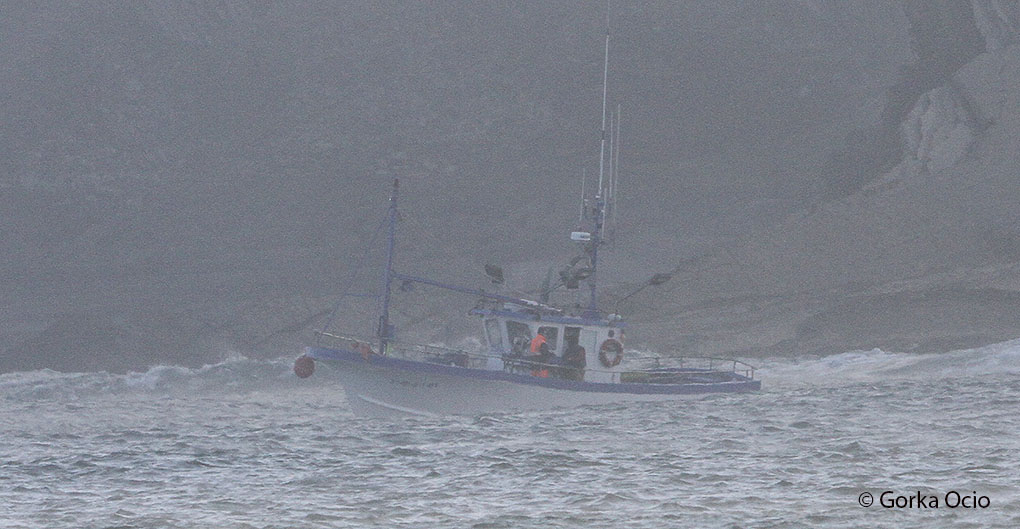
Lo mismo nos ha pasado con los amenazados Cormoranes moñudos (Pharacrocorax aristotelis). Las voces de alerta de nuestros compañeros David Álvarez y Jon Hidalgo sobre las graves amenazas que se ciernen sobre las poblaciones asturianas y vascas que estudian, con la utilización de tresmallos por parte de pescadores “artesanales”... redes de fondo y nada selectivas que se arrian muy cerca de la costa. Este último domingo 9 de diciembre nos vimos sorprendidos con dos pesqueros cántabros arriando sus redes muy cerca de la orilla y en la playa de Ereaga. Lugar habitual de pesca de nuestros amenazados cormoranes y otras aves buceadoras.


Estas aguas las utiliza entre otros, un cormorán moñudo jóven y anillado por Jon Hidalgo en la Isla de Billano (Bizkaia). La anilla verde con los dígitos AX nos permite conocer un poco más sobre su zona de invernada y costumbres pesqueras.


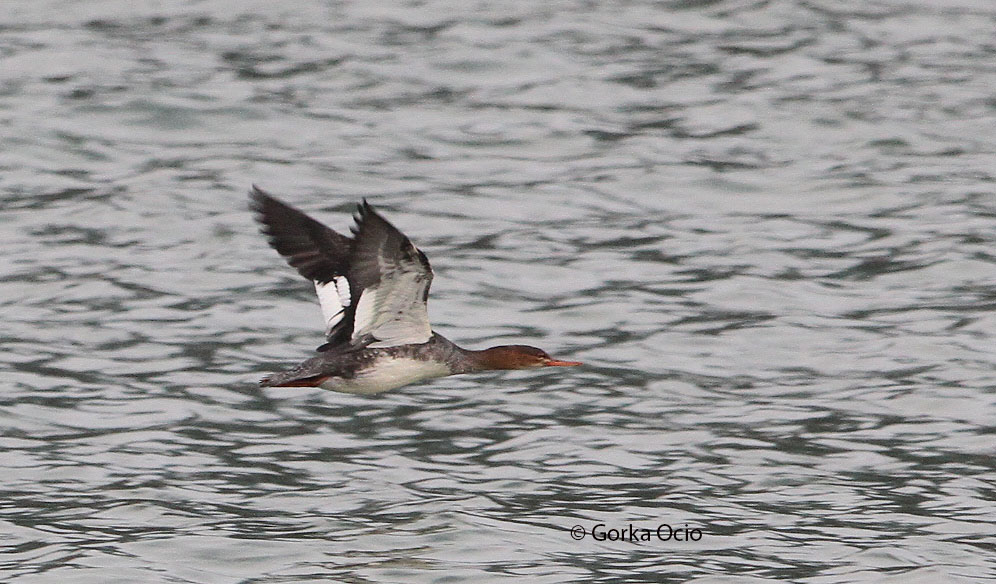
Estas aguas abiertas también están siendo utilizadas por unos pocos Somormujos lavancos (Podiceps cristatus), una solitaria hembra tuerta de Serreta mediana (Mergus serrator)

así como un par de Negrones comunes... hembra adulta (Melanitta nigra)...

hembra jóven...

Con las nieblas matinales hemos sorprendido a otras aves menos habituales y que en algunos casos han preferido hacer un alto en el camino esperando una mejoría para continuar su migración. Esto ha hecho un grupito de Ánades frisos (Anas strepera)

Cercetas comunes (Anas crecca), Ánades reales (Anas platyrhynchos)

e incluso media docena de Grullas comunes (Grus grus), aunque estas no llegaron a posarse.

En sus orillas y alimentándos en pequeñas charcas y en las rocas encontramos a la Garceta común (Egretta garzetta)

a los inquietos Correlimos oscuros (Calidris maritima)

un solitario Correlimos tridáctilo (Calidris alba)

Andarrios chico (Actitis hypoleucos)

y prácticamnete por todas sus orillas incluso andando entre la gente a los cada vez más abundantes y confiados Vuelvepiedras (Arenaria interpres).

Enfrente del Marítimo de Las Arenas hay un velero con un inmovil habittante. Un buho real mantiene firme su guardia para evitar que las gaviotas y cormoranes grandes (Pharacrocorax carbo) manchen con sus deyecciones la embarcación. Se trata de un pájaro de plástico y sí ha cumplido su cometido... la embarcación no presenta manchas de pájaros... sin embargo no podemos decir lo mismo de él. Está literalmente cagado por las aves. Ya no muestra peligro y éstas parecen “vengarse” ante tanta osadia. La verdad es que nos provocó una buena sonrisa.


Si bien este señuelo es ninguneado por los cormoranes, la persecución al que están siendo sometidos por la presión de los pescadores “deportivos” los han vuelto excesivamente desconfiados. Es una gran pena. Ya no dejan ni pasar a más de cien metros de distancia de ellos mientras remontamos la ría. A la mínima levantan el vuelo. Aunque quienes se acerquen a ellos sean deportistas desde sus embarcaciones a remo.


Menos esquivos tenemos a los pequeños Zampullines cuellinegros (Podiceps nigricollis)


En cuanto a gaviotas. No tiene nada que ver con otros años y más tras el cierre del vertedero de getxotarra de Fadura. Sólo podemos disfrutar de abundantes gaviotas medianas y pequeñas coincidiendo con temporales. Así podemos disfrutar de buenos números de Gaviotas enanas (Larus minutus)


y de Gaviotas cabecinegras (Larus melanocephalus).


Otras gaviotas... las patiamarillas (Larus michaellis)

Gaviotas reidoras (Larus ridibundus)


Gaviotas sombrías (Larus fuscus graellsii)

Un saludete

Gorka Ocio

2012/12/07

Drought in the Horn of Africa Delays Migrating Birds

Iturria: Science Daily


ScienceDaily (Dec. 6, 2012)The catastrophic drought last year in the Horn of Africa affected millions of people but also caused the extremely late arrival into northern Europe of several migratory songbird species, a study published December 6 in Science shows. Details of the migration route was revealed by data collected from small backpacks fitted on birds showing that the delay resulted from an extended stay in the Horn of Africa.


Thrush nightingale. (Credit: Mikkel W. Kristensen)
The extensive 2011 drought in the Horn of Africa had significant consequences for European songbirds such as thrush nightingale and red-backed shrike. These birds visit northern Europe every spring to mate and take advantage of ample summer food resources.
However, their spring migrating route from southern Africa to northern latitudes passes directly through the Horn of Africa, where the birds stop to feed and refuel for the next stage of their migration.
"Our research was able to couple the birds' delayed arrival in Europe with that stopover in the Horn of Africa. Here they stayed about a week longer in 2011 than in the years before and after 2011. Because of the drought, the birds would have needed longer to feed and gain energy for their onward travel, causing delayed arrival and breeding in Europe. This supports our theory that migrating animals in general are dependent on a series of areas to reach their destination,"says Associate Professor Anders Tøttrup from the Center for Macroecology, Evolution and Climate at the University of Copenhagen.
Data loggers as a backpack
The late spring arrival of European songbirds such asthrush nightingale and red-backed shrike perplexed researchers and bird watchers in 2011.
This mystery was even greater considering these songbirds' tendency to arrive progressively earlier over the last 50 years as climate change has made its impact.
By placing small data loggers on the backs of several birds in the autumn before their migration to Africa, and retrieving them in the spring when the birds returned to Europe, the scientists were able to trace the migration route and stopover sites. These data revealed a delay in the particular stopover in the Horn of Africa. Additionally, it was noted that other migrating birds not passing through the Horn of Africa arrived in Europe at the expected time.
"We have reconstructed 26 migration routes based on data from the small 'data backpacks' weighing just 1 gram. This new technology provides us with a detailed picture of the birds' migration and stopovers. It is brand-new territory to be able to track animals this small over such great distances," says Associate Professor Kasper Thorup from the Center for Macroecology, Evolution and Climate at the University of Copenhagen.
Delayed breeding
The birds' late arrival in 2011 also meant a similarly late breeding year.
"There are no signs of implications on the birds' breeding success and thereby the size of the population. But it is possible that we haven't yet seen the full effect of the delayed year," concludes Anders Tøttrup.
The research was carried out in collaboration with Lund University in Sweden.


Story Source:
The above story is reprinted from materials provided by University of Copenhagen.

Strategies to Prevent Others from Stealing Food

Iturria: Science Daily


ScienceDaily (Dec. 4, 2012) In order to prevent other birds from stealing the food they are storing for later, Eurasian jays, a type of corvid, minimizes any auditory hints a potential pilferer may use to steal their cache (food that is buried for later use). The new research was published December 5, in the journal Proceedings of the Royal Society B.


This is an Eurasian jay. (Credit: Kylie Millar)
Corvids are prolific cachers (or hoarders), burying food such as acorns in several thousand locations over the course of a year. When food becomes scarce during winter and spring, they remember where they buried their caches and retrieve the food items. However, pilfering of caches is commonplace. As a result, they are often trying to minimize other birds stealing their food and maximize the food that they steal.
In the first experiment, the researchers gave the jays options to hide food in substrates which varied in the amount of noise they made (a tray containing noisy gravel and a tray containing quiet sand). The birds' preferences for using these different substrates were tested when they were alone, when they had another bird that could see and hear them and when there was another bird that could hear but could not see them.
The researchers found that if a Eurasian jay is caching and hears but does not see another bird nearby it will hide its cache in the less noisy substrate (for this study, sand rather than gravel). This is presumably done to avoid drawing unwanted attention from potential thieves that might then try to view the location of the cache.
In the second experiment, the scientists measured how many times the subjects vocalised depending on whether they were watching another jay caching, another jay stealing caches that the subject had made themselves, another jay that was not caching or stealing, or an empty compartment that contained no jay.
They found that pilfering birds vocalise less when spying on another bird caching compared to when they are alone. The researchers believe that the jays are quieter in order to prevent their presence becoming known to the caching bird that might otherwise hide their cache elsewhere or stop hiding food.
Rachael Shaw, a PhD student at the University of Cambridge and co-author of the paper, said: "As humans, we understand that other people can hear what we are doing, but there is only limited evidence for this ability in other animals. Our study of Eurasian jays is the first to report that a member of the crow family will suppress acoustic information by vocalising less when spying on another individual that is caching."


Story Source:
The above story is reprinted from materials provided by University of Cambridge. The original story is licensed under a Creative Commons Licence.
Note: Materials may be edited for content and length. For further information, please contact the source cited above.

Journal Reference:
  1. Rachael C. Shaw and Nicola S. Clayton. Careful cachers and prying pilferers: Eurasian jays (Garrulus glandarius) limit auditory information available to competitors. Proc. R. Soc. B., 2013 280 20122238 DOI: 10.1098/rspb.2012.2238

Hatching Order Influences Birds' Behavior

Iturria: Science Daily

ScienceDaily (Dec. 7, 2012)The hatching order of birds influences how they behave in adult life according to research from the Lancaster Environment Centre. Dr Ian Hartley and Dr Mark Mainwaring (LEC) are the authors of the study in Animal Behaviour, which looked at how the birds' behaviour was affected by the way their parents cared for them as hatchlings.


The youngest members of zebra finch broods are more adventurous than their older siblings in adult life. (Credit: Image courtesy of Lancaster University)
They found that the youngest members of zebra finch broods are more adventurous than their older siblings in adult life.
Dr Hartley said that the study showed for the first time that hatching order influences birds' "behavioural repertoires" in adulthood.
Hatching eggs over a period of time, rather than all at once, is known as "hatching asynchrony" and occurs when eggs are incubated as soon as they are laid. For a zebra finch, this means that birds born up to four days apart can share the same nest and must compete for food.
The researchers experimentally controlled hatching synchrony within clutches, so that some clutches hatched simultaneously, while others hatched over a period of days. They then tested the behaviour of over one hundred offspring as adults. They found the youngest birds from asynchronously hatched clutches explored their environment more widely.
They measured how explorative the zebra finches were by recording how many times they visited bird feeders within an unfamiliar test aviary. They found that the youngest offspring in a brood approached the feeders significantly more often than their peers within a 30 minute period.
Researchers wanted to know how the method of rearing affected the behaviour of offspring beyond the nest, once they were living as independent adult birds. The results have implications for understanding how environmental stability might influence behaviours, and how flexible animals might be at coping with environmental change


Story Source:
The above story is reprinted from materials provided by Lancaster University.
Note: Materials may be edited for content and length. For further information, please contact the source cited above.

Journal Reference:
  1. Mark C. Mainwaring, Ian R. Hartley. Hatching asynchrony and offspring sex influence the subsequent exploratory behaviour of zebra finches. Animal Behaviour, 2012; DOI: 10.1016/j.anbehav.2012.10.009

2012/12/03

Ecologists shed new light on effects of light pollution on wildlife

Ecologists shed new light on effects of light pollution on wildlife

Iturria: Science Daily

ScienceDaily (Nov. 27, 2012)Light pollution is often associated with negative effects on wildlife. Now, ecologists have found that by mimicking a perpetual full moon, the gas flares and electrical lighting along Scotland's Forth estuary are helping shorebirds stock up on more food during the winter to fuel their spring migration.


VHF tracking in front of Grangemouth refinery. (Credit: Copyright Hamish Campbell)
The research is the first to use night-time light data from US military satellites to study animal behaviour.
Coasts and estuaries are among the most rapidly developing areas on Earth. Night-time satellite images of the planet show that except Antarctica, continents are ringed with halos of brightly-lit human development. But coasts are also key wildlife sites. Every year, millions of waterbirds arrive from the Arctic to overwinter on UK coasts, yet scientists remain largely in the dark about how these birds respond to the bright lights of coastal cities and industry.
To shed light on the issue, Dr Ross Dwyer and colleagues from the University of Exeter's Biosciences department investigated how artificial light affected feeding habits of the common redshank in the Forth estuary, one of Scotland's most industrialised coasts. As well as major industry such as Grangemouth oil refinery and Longannet power station, whose lights and gas flares illuminate the intertidal areas at night, the estuary's pristine salt marsh and mudflats are home to hundreds of thousands of migrating birds each winter.
Dr Dwyer measured the amount of artificial light in the Forth estuary at night using satellite images from the US Air Force. Although they have been previously used to study electrical power consumption, this is the first time such US military data has been used in animal behaviour research.
He then worked out how the light affected the birds' foraging behaviour by attaching tiny radio transmitters to the backs of 20 redshanks. The devices monitored the birds' location and contained posture sensors to detect how often the birds put their heads down to feed.
Generally, redshanks need to forage day and night during the winter to find enough food. These birds usually forage by sight during the day, which provides them with the most food, and less efficiently at night by locating prey by touch using their bills.
The study found that artificial light had a major impact on how redshanks searched for food, allowing them to forage more efficiently. At night, birds in brightly-lit areas foraged for longer and foraged by sight, rather than touch, compared with birds under darker night skies.
According to Dr Dwyer, who was based at the University's Cornwall campus at the time of the study: "Artificial light from industrial areas strongly influenced the foraging strategy of our tagged birds. It was as if the 24-hour light emitted from lamps and flares on the Grangemouth oil refinery site created, in effect, a perpetual full moon across the local inter-tidal area which the birds seemed to capitalise on by foraging for longer periods at night and switching to a potentially more effective foraging behaviour to locate prey."
The results contrast with other studies, which have found adverse effects of light pollution on wildlife. Previous research found artificial light caused newly-hatched turtles to head away from the sea, rather than towards it, and caused seabirds such as petrels to collide with lighthouses and other lit structures.
Named for their long bright orange or red legs, the common redshank is a medium-sized shorebird with a greyish brown back and wings in winter, and a black-tipped orange bill. On their wintering sites, the birds patrol estuaries and coastal lagoons feeding on molluscs, worms and crustaceans. Redshanks are generally very wary and nervous birds. Often the first to panic, they give noisy 'teu-hoo' alarm calls, earning them the nickname 'sentinel of the marshes'.
Redshanks are widely distributed, breeding and wintering across temperate Europe and Asia. Although numbers are in decline, the species is widespread and quite plentiful in some regions, and thus not considered a threatened species by the IUCN.